
When shopping for Yixing Zisha teapots, you will often come across two main production types: hand thrown pots and molded pots. Many buyers only focus on the price and appearance, without knowing how the production method affects the brewing experience and collection value. Even if two pots look almost identical on the outside, their clay density, air permeability and long-term patina performance can be quite different because of different making processes.
Hand thrown Yixing Zisha teapot is shaped by rotating clay on the pottery wheel, with the clay pulled and formed by the maker’s hands. The clay fiber keeps a natural and continuous state during forming. The wall thickness is not perfectly uniform, and you can feel subtle changes when running your fingers along the pot inner wall. The inner surface usually has soft spiral traces from wheel rotation, which are not neat mechanical lines. These natural marks are not flaws, but unique marks left by handwork.
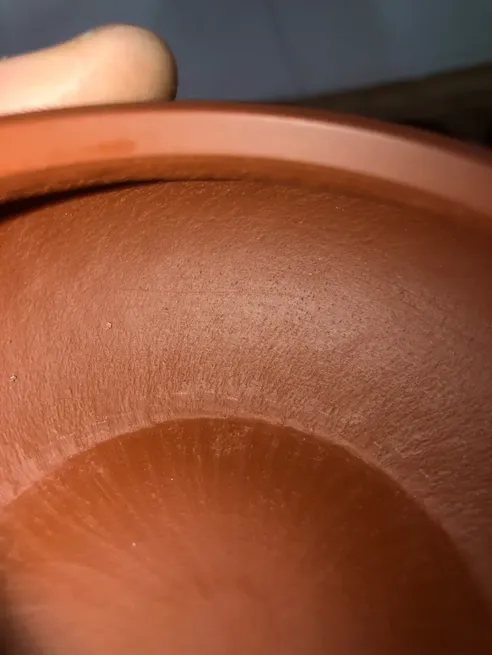
Molded teapots are made by pressing clay into pre-made molds, which can quickly copy the same shape in large quantities. Molded pots have very even wall thickness and clean, consistent outlines. They look neat and symmetrical at first glance. But the clay fiber is broken during pressing, so the overall breathability is weaker compared with hand thrown pots of the same clay material. The inner wall is usually smooth without natural hand traces, and sometimes you can find faint parting lines on the pot body where the mold pieces join together.
Hand thrown pots show better and more stable flavor adjustment when brewing tea. The natural clay structure helps soften the tea soup and enrich the layered aroma. Molded pots still work for daily brewing, but they are harder to build thick, translucent patina even after years of use. The patina on molded pots often stays superficial and dull, instead of blending naturally into the clay texture.
It is also important to adjust your expectation on price. Hand thrown pots take far more time and skill, so their price is generally higher. Molded pots are affordable for beginners who want simple Zisha brewing experience. Do not blindly believe that all molded pots are bad, or all hand thrown pots are high quality. A poorly thrown pot with bad clay can perform worse than a carefully made molded pot with good raw clay.
The easiest way to tell them apart is to check the inner wall, bottom and joint marks. Learn to compare multiple pots, and you will slowly recognize the natural warmth of handwork and the standard uniformity of molded works. Choose the one that matches your budget and tea needs, instead of chasing handwork labels blindly.
Leave a Reply